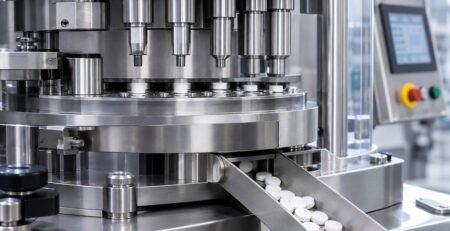
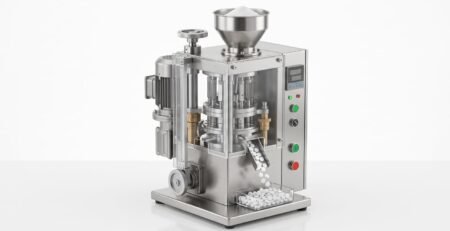
Tablet production is a crucial process in the pharmaceutical and food supplement industries. Different types of tablet presses are used, each with their own specific advantages and disadvantages. Two of the most common types are the single-station and multi-station tablet presses. In this article, we will compare the two machines in detail to shed light on their functionality, efficiency, flexibility and areas of application.
Single stationary tablet presses
Single-station tablet presses, also known as single-station presses, are machines that perform a single pressing operation per cycle. They are usually more compact and easier to handle, which makes them ideal for smaller production facilities or for companies that only need to produce small quantities of tablets.
The operation of these machines is often less complex, which makes it easier to train employees. Another advantage is the lower investment costs compared to multi-station presses. The main application of these machines is in the production of prototypes or in the production of batches with limited volume. When formulating new products, it is often necessary to try out different recipes. The flexibility of the single-station press is an advantage here, as it can be quickly converted to produce different tablet shapes or sizes.
Disadvantages of single-station presses
The production speed of single-station presses is generally lower than that of their multi-station counterparts. As each tablet is pressed individually, these machines cannot keep up with the high production speeds required for larger production runs. This can be a disadvantage when there is high demand or large production volumes are required.
Multi-station tablet presses
In contrast, multi-station tablet presses are designed for mass production. They have several pressing stations that make it possible to press several tablets at the same time. These machines are designed to produce large quantities of tablets in a short time, making them ideal for industrial production.
The higher efficiency of these machines leads to a reduction in production costs per tablet, which is crucial for companies that want to remain competitive. Another advantage of multi-station presses is their ability to ensure consistent tablet quality. By using multiple pressing stations, an even distribution of pressure and materials can be ensured, resulting in better consistency in tablet size and weight. This is particularly important in the pharmaceutical industry where accurate dosages are crucial.
Disadvantages of multi-station presses
However, multi-station presses are also associated with higher investment costs. The complexity of the machine often requires extensive training for operators and careful maintenance to ensure that the machines work efficiently and reliably. In addition, these machines are often less flexible in terms of product variations as they are optimized for specific production lines.
Decision factors
The choice between a single-station and a multi-station tablet press ultimately depends on the specific needs of the company. Smaller companies or start-ups focused on new product development or limited volume production may benefit from the flexibility and lower cost of single-station presses. On the other hand, larger companies looking for efficiency and cost reduction may need the benefits that a multi-station press offers.
Conclusion
In summary, it can be said that both types of Tablet Press have their own advantages and disadvantages, which must be carefully weighed up. While single-station presses offer flexibility and easy handling, multi-station presses impress with their efficiency and production capacity. The right decision depends on the company's individual requirements and objectives.
FAQs – Vergleich von Einzelstationären und Mehrstationären Tablettenpressen
1. Was ist der Unterschied zwischen Einzelstationären und Mehrstationären Tablettenpressen?
Einzelstationäre Tablettenpressen haben nur eine Pressstation und eignen sich für kleinere Chargen, während Mehrstationäre Tablettenpressen mehrere Stationen besitzen und hohe Produktionsmengen effizient verarbeiten können.
2. Welche Tablettenpressmaschine ist für den Heimgebrauch geeignet?
Für den privaten Gebrauch oder kleinere Labore eignen sich kompakte Einzelstationäre Tablettenpressen, da sie einfach zu bedienen und kostengünstig sind.
3. Können Mehrstationäre Tablettenpressen verschiedene Tablettengrößen herstellen?
Ja, moderne Mehrstationäre Tablettenpressen bieten oft flexible Matrizen und Stempel, um unterschiedliche Tablettengrößen und Formen herzustellen.
4. Wie unterscheidet sich die Wartung zwischen Einzel- und Mehrstationären Pressen?
Einzelstationäre Pressen sind wartungsärmer, während Mehrstationäre Pressen durch die Vielzahl der beweglichen Teile eine intensivere Pflege und regelmäßige Kontrolle erfordern.
5. Welche Maschine ist wirtschaftlicher für die Massenproduktion?
Mehrstationäre Tablettenpressen sind für die industrielle Produktion wirtschaftlicher, da sie hohe Stückzahlen in kürzerer Zeit herstellen können.
6. Kann man Tablettenpressen online kaufen?
Ja, es gibt zahlreiche Anbieter für Tablettenpressen, sowohl für den Heimgebrauch als auch für industrielle Anforderungen, inklusive Tablettenmaschine, Tablettenpresse oder Tabletten-Pressmaschine.