What is a tablet press and how exactly does it work?
A modern tablet press is the technological heart of modern pharmaceutical production, the chemical industry, and the manufacture of dietary supplements. As a highly sophisticated unit for solid dosage forms, it processes powdered raw materials or pre-conditioned mixtures into precisely shaped tablets through mechanical compression. Such industrial plants must meet the strictest regulatory requirements, such as Good Manufacturing Practice (GMP) guidelines, to guarantee absolute freedom from contamination and flawless batch traceability. Engineers and process technicians continuously optimize these production plants with regard to energy efficiency, minimized tool wear, and maximum output, as any deviation in industrial pharmaceutical operations can have serious economic and health consequences.
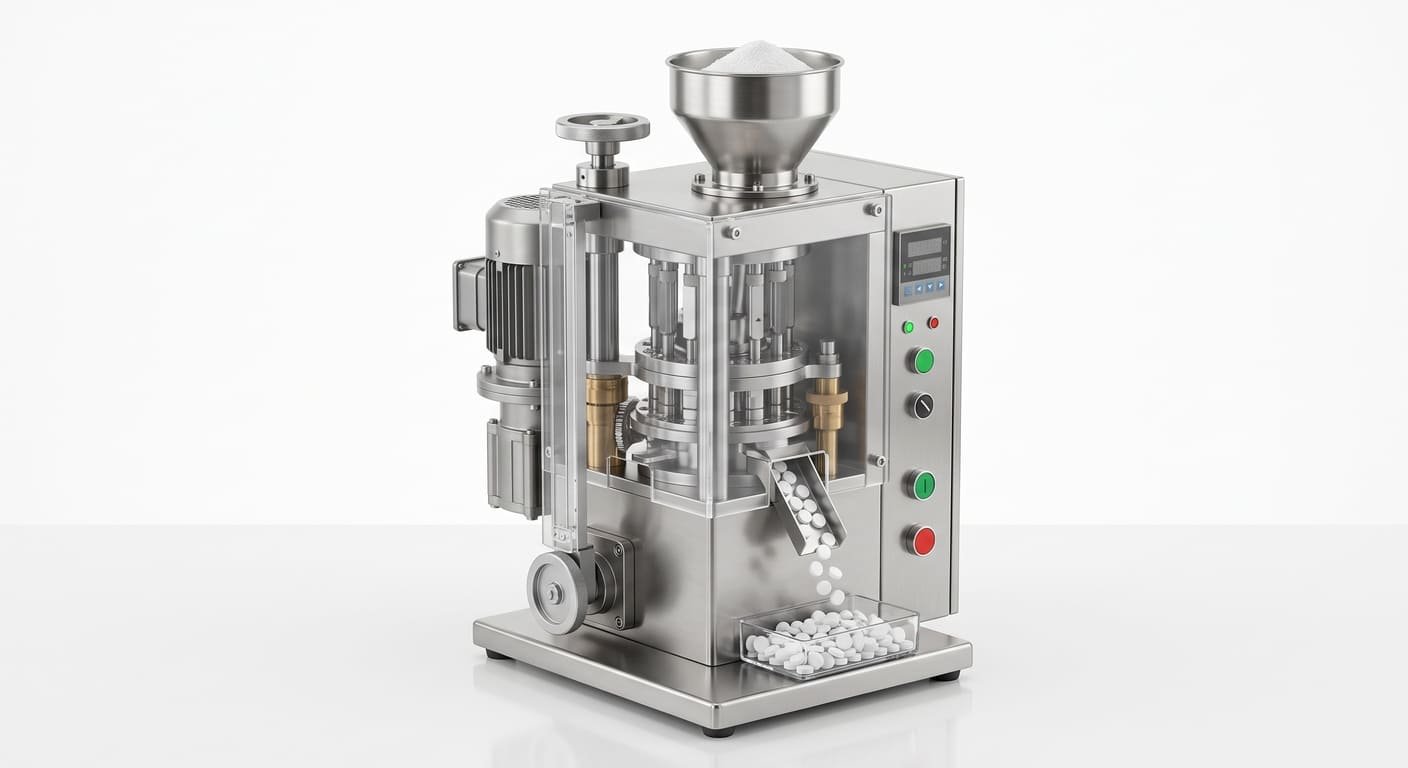
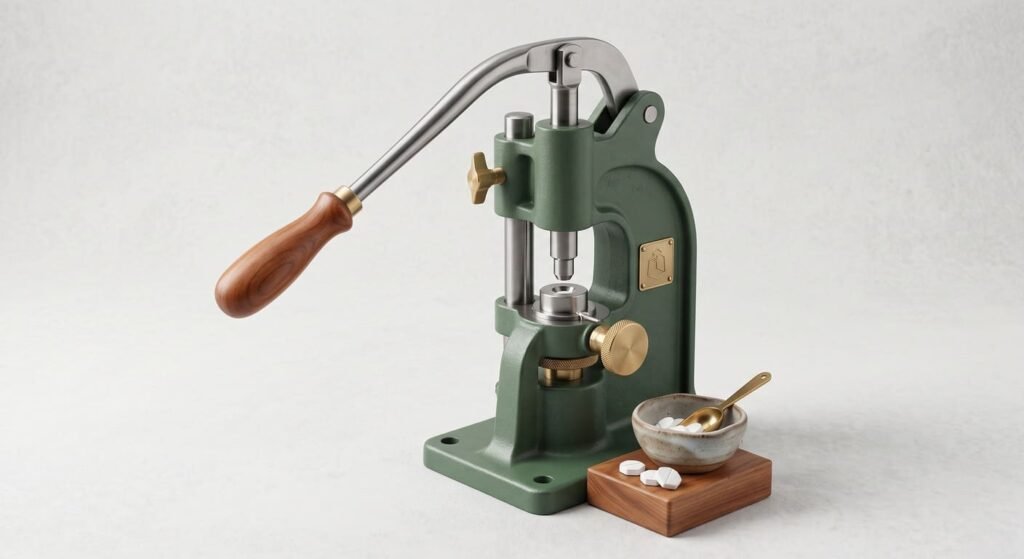
The core process relies on the perfect interplay of the die, upper punch, and lower punch, which together form the central pressing station. The work cycle begins with precise volumetric dosing, in which free-flowing powder or fine granules are fed into the die bore via an automatic filling shoe. After the precise removal of excess material, the main mechanical force takes effect, as the upper punch and the lower punch simultaneously exert immense pressure on the formulation mixture from above and below, respectively. This powerful powder compression, overcoming elastic and plastic deformation limits, causes the particles to interlock permanently, resulting in the necessary tablet hardness and structural integrity.
For a smooth and error-free production process, the physicochemical properties of the bulk material play an absolutely crucial role. Parameters such as bulk density, residual moisture, particle size distribution, and specific flow behavior significantly determine whether an active ingredient can be processed homogeneously or whether undesirable segregation processes occur. Since many pharmaceutical raw materials inherently exhibit poor flow properties, a preliminary process step such as wet granulation or compaction using a roller compactor is usually essential before the actual tableting process. Only through optimal preparation of the material to be compressed can phenomena such as capping, lamination, or unacceptable weight variations in the finished product be effectively prevented.
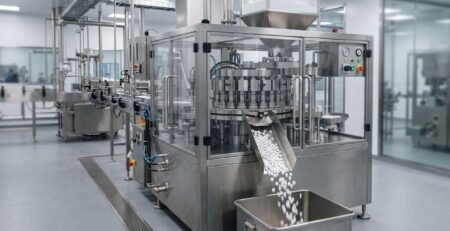
In large-scale industrial production, two main types of machines are used: classic eccentric presses for smaller batches and high-performance rotary presses for mass production. A rotary press has a massive die table with dozens of pressing stations, enabling extremely high output rates of hundreds of thousands of units per hour. To ensure that these high-speed machines operate precisely despite extreme mechanical stresses, the punches and dies are made of high-strength, alloyed special steel, which can also be coated with special surface finishes. This reliably prevents the workpiece from sticking and minimizes abrasive wear on the heavily stressed tools during continuous operation.
Furthermore, modern high-tech tablet presses feature sophisticated, PLC-controlled automation systems with integrated process analysis and real-time measurement electronics. Sensors continuously monitor the punch travel, the actual compression pressure, and the restoring forces to intervene fully automatically at the slightest deviations from tolerances. This inline weight control and the automatic rejection of defective tablets guarantee seamless quality control without manual interruption. Advanced containment systems to protect the operator and the environment, along with CIP and WIP cleaning functions, make these machines perfectly equipped for the demanding processing of highly potent substances in modern active pharmaceutical ingredient (API) production.
Die moderne Pharmaindustrie und die Nahrungsergänzungsmittelbranche stehen kontinuierlich vor der Herausforderung, enorme Stückzahlen bei gleichbleibend hoher Qualität zu produzieren. Hier...
Die Herstellung von Tabletten hat sich im Laufe der Jahrzehnte von einem einfachen handwerklichen Prozess zu einer hochkomplexen, technologisch fortgeschrittenen...
Die pharmazeutische Produktion steht unter einem stetigen Druck, Durchsatzraten zu erhöhen, die Produktqualität zu stabilisieren und gleichzeitig die Betriebskosten durch...
Die Wahl der richtigen Tablettenpressmaschine stellt für Pharmaunternehmen, Nahrungsergänzungsmittelhersteller und F&E-Labore eine zentrale strategische Entscheidung dar. Die Herausforderung besteht darin,...