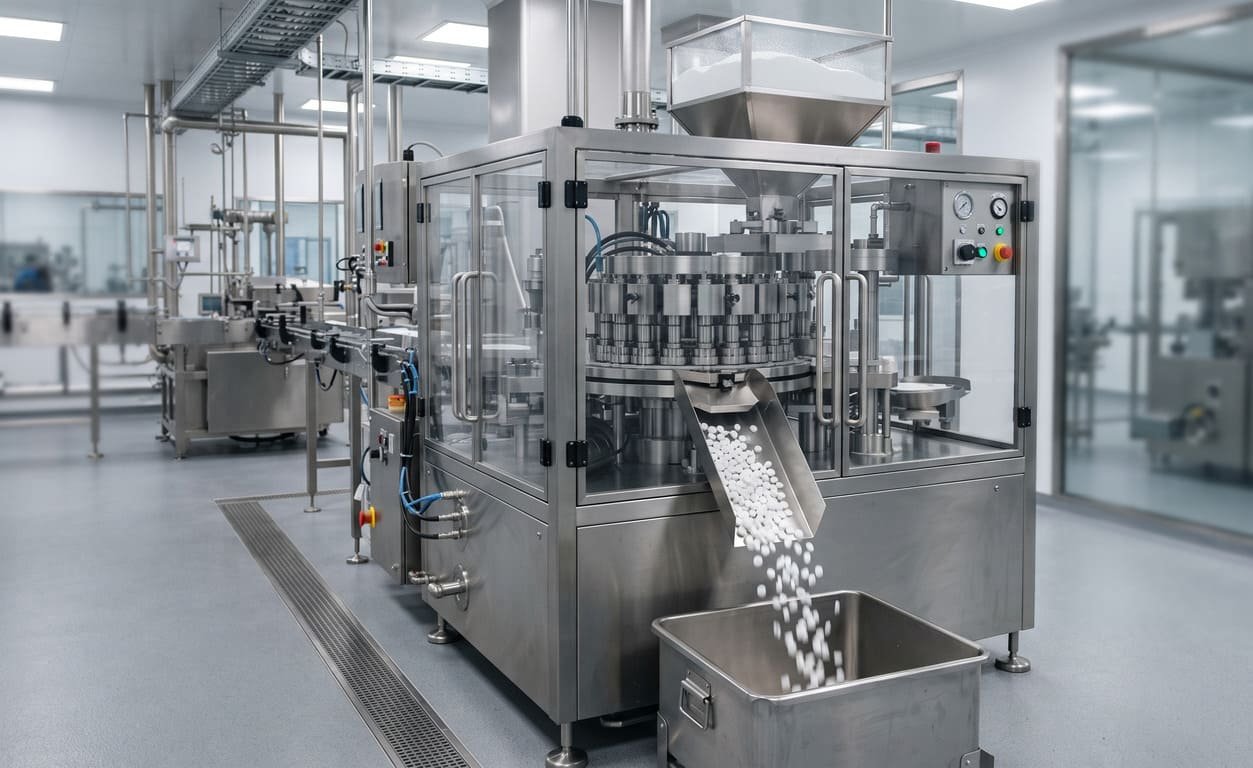
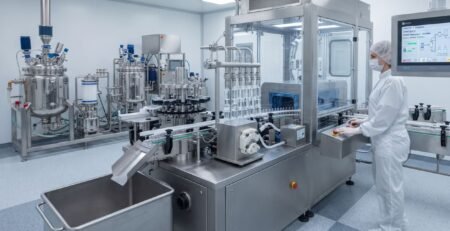
Pharmaceutical production is under constant pressure to increase throughput rates, stabilize product quality, and simultaneously reduce operating costs through improved plant efficiency. In this context, the mechanical analysis of tablet presses plays a central role, as it determines the fundamental dynamics of the compression process. An efficient, automated production line is not a static structure, but rather a complex interplay of mechanical precision, material flow dynamics, and intelligent control technology. To sustainably increase overall equipment effectiveness (OEE), the focus must be on understanding the mechanical stress limits and the synchronization of the rotating components, since any irregularity in the mechanical process directly leads to quality deviations such as weight fluctuations or hardness defects. Mechanical analysis begins at the interface between the compression tool and the tablet material. Here, the residence time under maximum compression pressure is a crucial factor, significantly influenced by the rotational speed and the geometry of the cam segments. Through precise mathematical modeling of these motion sequences, engineers can identify critical vibration modes that could lead to instabilities at high speeds. In modern automated systems, this mechanical stability is supported by adaptive control systems that react in real time to even the smallest deviations in the force-time profile. Significant efficiency gains can be achieved by minimizing mechanical wear through targeted optimization of lubrication cycles and material pairings on the die guides. This not only prevents costly downtime but also ensures consistent mechanical tolerance over long production runs. Furthermore, the integration of sensors to monitor the pressure force distribution allows for dynamic adjustment of the filling depth, drastically reducing material loss and maximizing output per unit of time.
Strategies for mechanical process optimization in mass production
Optimizing efficiency in an automated line requires a holistic approach that extends beyond the press's mechanics. It is essential to mechanically decouple the interfaces to downstream dust extraction and feeding systems to prevent vibrations from the press chamber being transmitted to the periphery. Precise mechanical calibration, combined with a predictive maintenance strategy based on vibration analysis, allows for the reliable exploration of the press's mechanical load-bearing capacity. When the press's mechanical architecture is precisely tailored to the physical properties of the granules being processed, the need for manual adjustments is minimized. This results in more stable process control, enabling the machine to operate at maximum speed for extended periods without the risk of overheating or premature fatigue of moving parts. The future of efficiency improvement lies in combining high-strength, low-wear materials for the cam segments with intelligent software that proactively incorporates the press's mechanical inertia into its control algorithms. In this way, mechanical performance and digital control merge into a single unit that not only increases output but also reduces process variability to a negligible level, ultimately significantly improving the economic efficiency of the entire production line in the pharmaceutical industry.