How to safely maximize the production speed of a standard tablet press
The production speed of a tablet press is a critical factor in the economic efficiency of industrial manufacturing processes. Whether in the pharmaceutical industry, the production of dietary supplements, or chemical manufacturing, an efficient tablet press enables higher output volumes, shorter production times, and better utilization of existing resources.
However, a higher machine speed does not automatically translate into a greater quantity of saleable tablets. Exceeding technical limits can lead to quality issues, increased tool wear, and unplanned downtime. It is therefore crucial to optimize the performance of a standard tablet press systematically, while ensuring full compliance with all safety requirements.
The most important factors for the production output of a tablet press
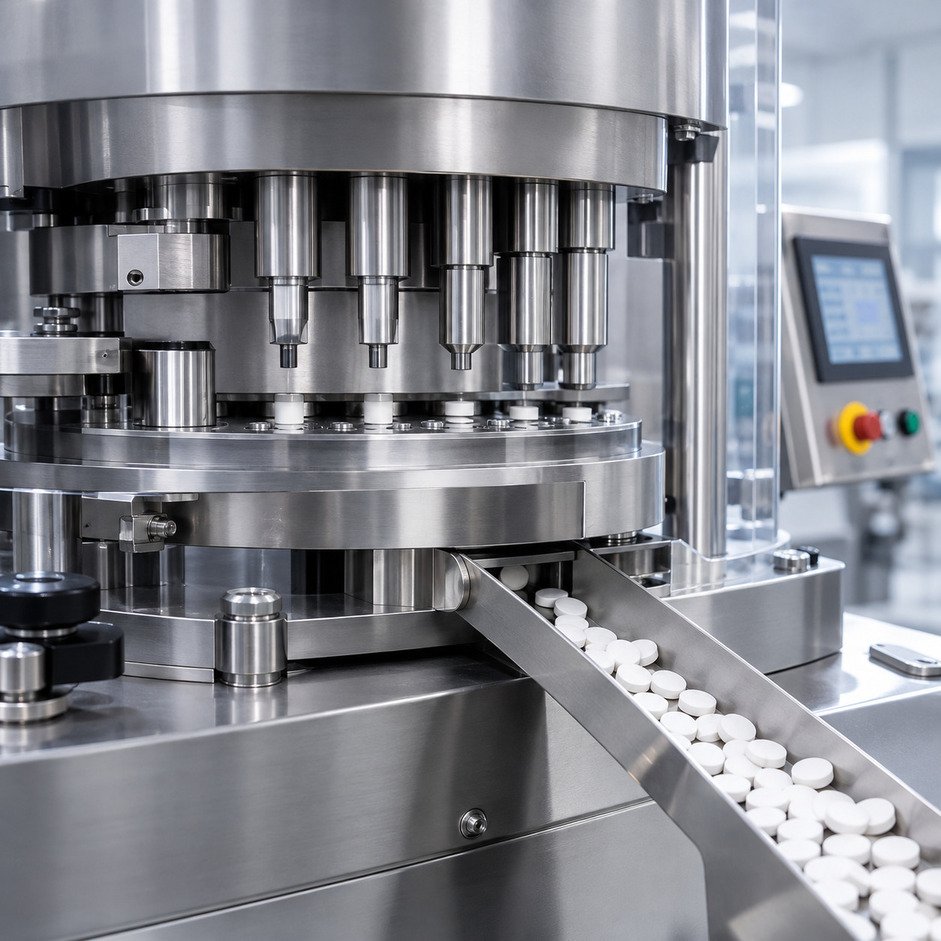
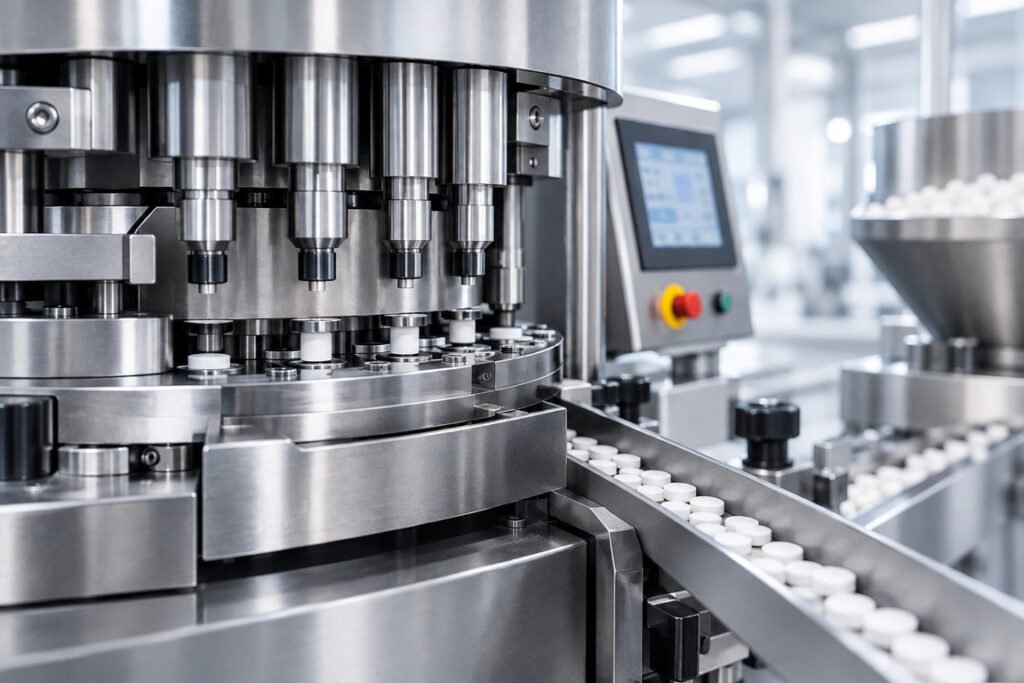
The actual production capacity depends on several technical and material-related factors. Of particular importance are the type of machine, the number of pressing stations, the rotational speed, the properties of the material being pressed, and the required compaction time.
For a rotary tablet press, the theoretical hourly output can be calculated based on the number of compression stations, the number of revolutions per minute, and the number of tablets produced per station.
A machine with 20 compression stations operating at 30 revolutions per minute can theoretically produce 36,000 tablets per hour, assuming one tablet per station. However, the actual yield of acceptable product may be lower due to rejects, material feed issues, quality inspections, and periods of downtime.
For a realistic performance assessment, manufacturers should therefore not focus solely on maximum rotational speed, but also take into account the stability of the entire production process.
Optimize machine speed incrementally
One of the most straightforward ways to increase output is by adjusting the rotational speed. In the case of rotary tablet presses, a higher rotational speed can increase the number of tablets produced per hour.
However, the speed may only be adjusted within the operating limits specified by the machine manufacturer. In doing so, the required die filling, the dwell time under pressure, and the mechanical load-bearing capacity of the tooling must be taken into account.
Excessive speed can result in tablets that are not sufficiently compacted or in weight variations. Therefore, a step-by-step optimization process, accompanied by documented product quality testing, is recommended.
The optimal speed is reached when the machine operates stably over an extended period and reliably meets the established quality requirements.
Ensure consistent material feed
A continuous flow of material is an essential prerequisite for a high production speed. Even a high-performance tablet press cannot reach its full capacity if powder or granules enter the dies unevenly.
Materials with poor flowability, uneven particle size distribution, or high sensitivity to moisture are particularly problematic. They can lead to incomplete die filling and fluctuations in tablet weight.
Improvements in material feed can be achieved through appropriate granulate properties, correctly adjusted feeding systems, and controlled environmental conditions.
For machines with positive feeding, the feeder setting should be adjusted to suit the specific material and the production speed. In doing so, care must be taken to ensure that the material is not subjected to excessive mechanical stress or segregation.
Properly coordinate pressing force and compaction time
De compressiekracht heeft een aanzienlijke invloed op de sterkte en structuur van de uiteindelijke tabletten. Onvoldoende compressie kan leiden tot broze producten, terwijl overmatige druk gereedschap kan beschadigen of ongewenste veranderingen in de eigenschappen van de tabletten kan veroorzaken.
As machine speed increases, the duration for which the material is subjected to pressure also changes. This so-called dwell time is particularly significant in the case of formulations that are difficult to compress.
Reliable performance optimization therefore requires considering pressing force, speed, and material behavior in conjunction.
For pharmaceutical products, validated process parameters and product-specific quality requirements must also be met. Changes outside the approved process range may not be implemented without appropriate assessment and authorization.
Regular maintenance reduces production downtime
A well-maintained tablet press operates more reliably and can sustain its intended performance over longer periods. Conversely, worn-out tooling, inadequate lubrication, or contaminated machine components can compromise production quality.
Key maintenance tasks include:
Regular inspection of punches, dies, and other wear parts.
Cleaning of components that come into contact with the product, in accordance with the manufacturer's specifications.
Inspection of lubrication points and moving machine elements.
Inspection of sensors, safety equipment, and monitoring systems.
Documentation of malfunctions, maintenance work, and tool changes.
Before maintenance work begins, the machine must be shut down in accordance with applicable safety procedures and secured against accidental startup.
A preventive maintenance strategy helps to identify technical issues early on and avoid unplanned downtime.
Consider tooling quality and tablet design
The punches and dies used influence not only the shape of the tablets but also the achievable production speed. Damaged or unsuitable tooling can lead to issues such as sticking, uneven compaction, and difficulties during tablet ejection. Conversely, high-quality tooling—well-matched to both the machine and the formulation—supports a stable production process. Tablet design also plays a significant role; complex shapes, deep embossments, or delicate edges can impose specific requirements on the compaction and ejection stages. Therefore, when selecting appropriate tooling, factors such as material properties, the desired tablet shape, machine compatibility, and cleaning requirements should all be considered in conjunction.
Improve quality control during production
Increasing production speed is only economically viable if the tablets produced meet the required quality standards. Relevant quality attributes include, for example, tablet weight, thickness, mechanical strength, friability, and—where applicable—disintegration or dissolution characteristics. Modern monitoring systems can help detect deviations at an early stage and make process fluctuations visible. Automated weight checks and the monitoring of compression force provide valuable information in this regard. It is important to note that control systems should not be viewed as a substitute for proper process validation; rather, they support the continuous monitoring of a manufacturing process that is already under control.
Combining production speed and workplace safety
Whenever performance is increased, the safety of operating personnel must be the top priority. Protective covers, interlocks, emergency stop devices, and other safety systems must never be bypassed in order to achieve higher speeds. Furthermore, factors such as dust generation, noise exposure, and potential hazards from moving machine parts must be taken into account. When processing combustible dusts, additional appropriate explosion-protection measures are required. The specific requirements depend on the materials used, the machine design, and the applicable regulations. Operating personnel should receive regular training and be familiar with the permitted operating parameters as well as the procedures to follow in the event of a malfunction.
Using Overall Equipment Effectiveness as a key performance indicator
The metric known as Overall Equipment Effectiveness (OEE) is a suitable tool for evaluating actual production performance. It takes into account three key aspects: availability, performance, and quality. This makes it clear whether production losses are primarily caused by downtime, reduced operating speed, or defective products.
A machine operating at a very high speed may, for instance, yield a poorer overall performance than a system running somewhat more slowly but with fewer defects and minimal interruptions. Regularly evaluating OEE makes it possible to identify potential improvements and prioritize optimization measures in a targeted manner.
Conclusion: Higher performance through stable processes
The most effective way to increase the production speed of a standard tablet press is to ensure that machine parameters, material properties, maintenance, and quality control are well-aligned. Rather than simply increasing the rotational speed, manufacturers should analyze the entire production process and implement technical improvements in a systematic manner.
Consistent material feed, suitable tooling, controlled compression conditions, and reliable machine monitoring form the foundation for high-quality output. The primary objective is not maximum theoretical speed, but rather a consistently reliable, stable, and economical tablet production process.
Eine moderne Tablettenpressmaschine ist das technologische Herzstück der modernen pharmazeutischen Produktion, der chemischen Industrie sowie der Herstellung von Nahrungsergänzungsmitteln. Als...
Die moderne Pharmaindustrie und die Nahrungsergänzungsmittelbranche stehen kontinuierlich vor der Herausforderung, enorme Stückzahlen bei gleichbleibend hoher Qualität zu produzieren. Hier...
Die Herstellung von Tabletten hat sich im Laufe der Jahrzehnte von einem einfachen handwerklichen Prozess zu einer hochkomplexen, technologisch fortgeschrittenen...
Die pharmazeutische Produktion steht unter einem stetigen Druck, Durchsatzraten zu erhöhen, die Produktqualität zu stabilisieren und gleichzeitig die Betriebskosten durch...