The Complete Guide to Pharmaceutical Tablet Compression (2026)
The tablet remains the dominant solid oral dosage form in the pharmaceutical industry, and for good reason: it offers precise dosing, storage stability, cost-effective manufacturing, and high patient acceptance. Compression—the process of compacting powders or granules under high pressure into a solid form—lies at the heart of this production method. By 2026, however, requirements are shifting significantly. Continuous manufacturing, real-time process monitoring, stricter regulatory expectations regarding data integrity, and growing pressure for greater sustainability are shaping daily operations in both development and production. This guide summarizes the essential fundamentals and current developments in the field.
Fundamentals of Tablet Compression and Formulation Strategy
The compression process essentially consists of three phases: filling the die, compressing the material between the upper and lower punches, and ejecting the finished tablet. Throughout this sequence, the powder bed undergoes several physical stages. Initially, the particles rearrange themselves, reducing the void volume; subsequently, the particles undergo elastic and plastic deformation—with fragmentation also occurring in the case of brittle materials. Which behavior dominates depends significantly on the properties of the active ingredient and the excipients. Materials capable of plastic deformation, such as microcrystalline cellulose, form stable tablets even under moderate pressure, whereas brittle substances, such as lactose monohydrate, are compacted primarily through fracture and rearrangement.
A well-conceived formulation strategy is therefore the prerequisite for a robust process. Depending on the properties of the active ingredient, developers choose between direct compression, wet granulation, and dry granulation. Direct compression is the most economical option, but it requires mixtures that flow well and are easily compressible. If these properties are insufficient, granulation can improve flowability, prevent segregation, and enhance content uniformity. Typical excipients include fillers, binders, disintegrants, lubricants, and glidants. The interplay between these components determines whether the tablet is mechanically stable and whether it will reliably disintegrate in the gastrointestinal tract to release the active ingredient.
Process parameters, tablet press, and tooling
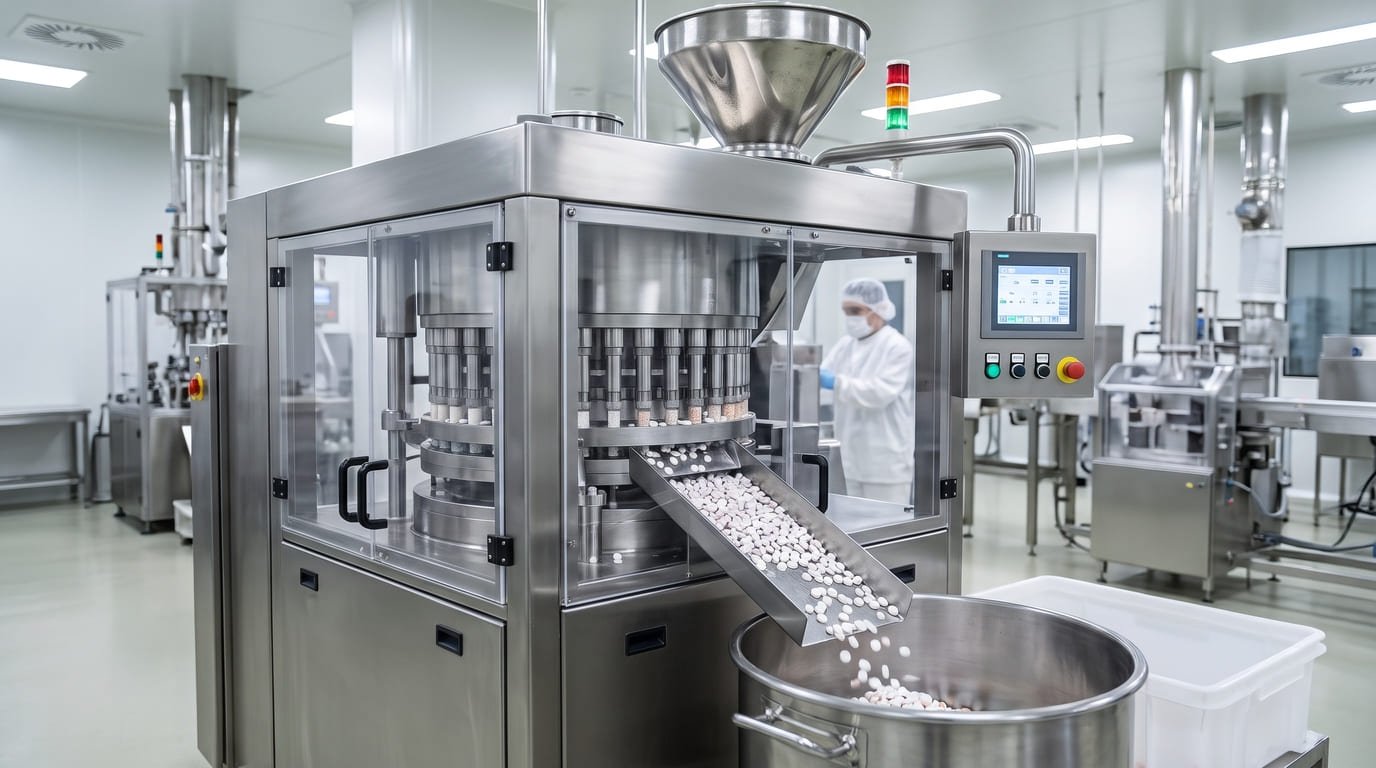
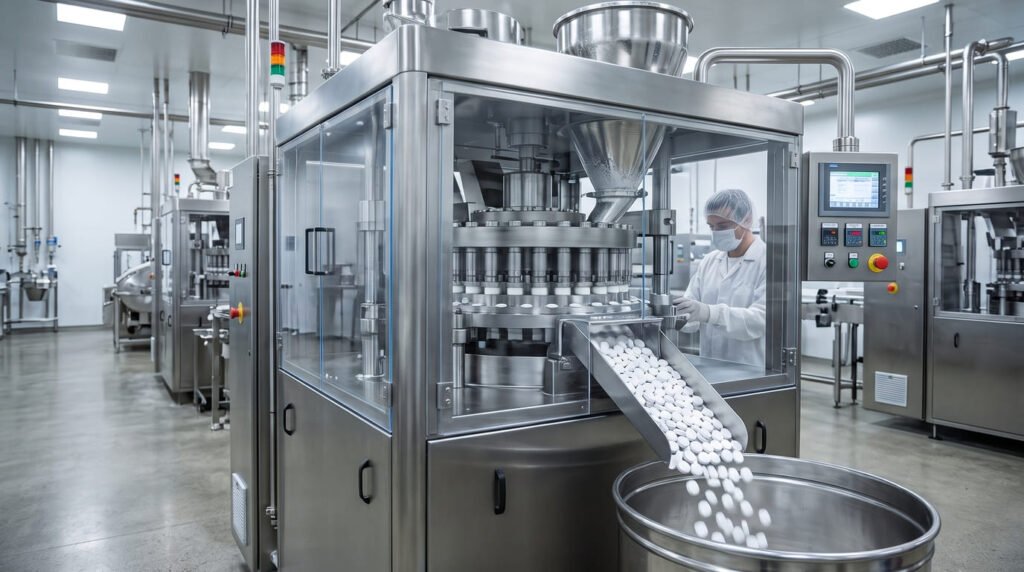
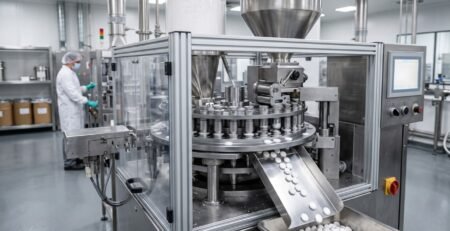
Modern rotary tablet presses can achieve output rates of several hundred thousand tablets per hour; however, speed alone is not an indicator of quality. What is crucial is that critical process parameters are understood, monitored, and maintained within defined limits. These primarily include compression force, fill depth, rotor speed, and forced feeding via the feed shoe. High rotor speed shortens the dwell time under pressure, which—in the case of viscoelastic materials—can lead to "capping" (the separation of the tablet's top layer) and reduced tablet hardness. Consequently, each product must be individually characterized with regard to its sensitivity to processing speed. Equally important are the selection and maintenance of the compression tooling, as these determine the shape, surface finish, and dimensional accuracy of every single tablet.
In practice, the following points have proven particularly effective for avoiding common issues such as sticking, capping, or weight variations:
Regular inspection and maintenance of punches and dies, as well as timely replacement in the event of wear
Optimized lubricant quantity and mixing time to prevent sticking, without compromising tablet hardness or disintegration time
Continuous monitoring of compaction force and tablet weight, with automatic feedback to the fill depth
Controlled room conditions for temperature and humidity, particularly for hygroscopic formulations
In addition, process development based on the "Quality by Design" principle plays a central role. Through the use of design of experiments (DoE), interactions between material properties and process parameters can be systematically captured, allowing for the definition of a "design space" within which quality is assured. This facilitates both the scale-up from laboratory to production level and any subsequent modifications, as the impact of an adjustment is already understood through the established model.
Quality Assurance, Digitalization, and Outlook for 2026
Quality assurance in tablet compression relies on a combination of in-process controls and release testing. Standard parameters include mass, hardness, thickness, friability, disintegration time, and content uniformity. However, there is a clear trend toward Process Analytical Technology (PAT). Inline measurements using near-infrared spectroscopy or Raman spectroscopy allow for the determination of active ingredient content and other quality attributes in real time, rather than requiring laboratory analysis after production. When combined with real-time release testing, this can shorten lead times, reduce scrap, and significantly accelerate batch release. This approach requires validated models and comprehensive, tamper-proof documentation that ensures data integrity in accordance with the ALCOA+ principles.
Three key developments are emerging for 2026. First, continuous manufacturing—where dosing, mixing, granulation, and compression are integrated into a single, unbroken production line—is gaining further importance. Second, data-driven methods are becoming a standard part of daily production: digital twins and machine learning support process optimization, enable the early detection of deviations, and facilitate predictive maintenance. Third, there is an increasing focus on energy efficiency, resource conservation, and solvent-free processes—driven in no small part by rising regulatory and societal expectations. Companies that integrate these trends into their strategies early on and ensure their teams are appropriately skilled will secure a clear competitive advantage in terms of quality, costs, and delivery capability.
Die Produktionsgeschwindigkeit einer Tablettenpresse ist ein entscheidender Faktor für die Wirtschaftlichkeit industrieller Fertigungsprozesse. Ob in der pharmazeutischen Industrie, bei der...
Eine moderne Tablettenpressmaschine ist das technologische Herzstück der modernen pharmazeutischen Produktion, der chemischen Industrie sowie der Herstellung von Nahrungsergänzungsmitteln. Als...
Die moderne Pharmaindustrie und die Nahrungsergänzungsmittelbranche stehen kontinuierlich vor der Herausforderung, enorme Stückzahlen bei gleichbleibend hoher Qualität zu produzieren. Hier...
Die Herstellung von Tabletten hat sich im Laufe der Jahrzehnte von einem einfachen handwerklichen Prozess zu einer hochkomplexen, technologisch fortgeschrittenen...