


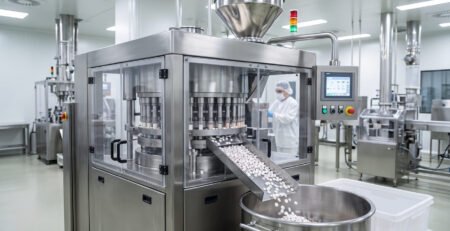
The Complete Guide to Pharmaceutical Tablet Compression (2026)
Die Tablette ist nach wie vor die dominierende feste orale Darreichungsform in der Pharmaindustrie, und das aus gutem Grund: Sie...
By
WORLDWIDE SHIPPING - Order now

Posted by:
Category:
Comments:
Post Date:
In the pharmaceutical industry, tablet presses play a central role in the production of solid dosage forms. Two of the most commonly used machine types are rotary and eccentric tablet presses. Despite their similar function—compressing powdered substances into tablets—these presses differ fundamentally in their design, functionality, capacity, and range of applications. The following comparison highlights the key features of both press types and explains the applications for which they are particularly suitable.
The eccentric or single-station press is the historically older design and is characterized by its simple mechanics. Its name derives from the eccentric drive, which generates an up-and-down movement of the press ram via a rotating shaft. This movement causes the powder to be compacted in a die and formed into a tablet. The eccentric press operates with only one pressing station, which makes it significantly slower than the rotary press. The production process is sequential: Powder is filled, compressed, demolded, and then the cycle begins again.
Eccentric presses offer several key advantages, especially in the areas of research, development, and small-batch production. Their simple design allows precise control over individual process parameters such as press force, fill height, or press speed. This flexibility makes them ideal for developing new formulations and for use in laboratory environments. Eccentric presses can also be used to test particularly difficult powder mixtures that require fine compression adjustments. Cleaning and tool changes are also easier with this design than with more complex rotary presses.
In contrast, the rotary press, also known as a rotary press, has a circular pressing tool that rotates continuously, serving multiple pressing stations simultaneously. The dies are arranged in a circle on a rotating disk, with pressing rams engaging from above and below. This machine can press dozens or even hundreds of tablets in a single rotation. The high speed and the ability to process in parallel make the rotary press the preferred choice for mass production.
A key advantage of the rotary press is its enormous output. Modern models can produce several hundred thousand tablets per hour without compromising consistency or quality. The continuous movement allows for consistent filling and compression, which is particularly crucial for high volumes. Combined with automated control and inline inspections, rotary presses meet the highest standards of reproducibility, process reliability, and efficiency. However, they are technically much more complex than eccentric presses and require correspondingly greater effort in terms of maintenance, calibration, and cleaning.
Another difference lies in the area of process integration. Rotary presses can be easily integrated into automated production lines. Functions such as automatic powder feeding, tablet ejection, breakage and weight control, or even optical inspection can be easily added. This makes them particularly attractive for large pharmaceutical companies that rely on high throughput rates and standardized processes. In contrast, eccentric presses are more isolated units that are usually filled and monitored manually.
Differences also emerge in energy efficiency and noise levels. Due to their continuous motion, rotary presses often operate more energy-efficiently at high loads, whereas eccentric presses can generate greater mechanical stress due to the constant acceleration and deceleration of the ram. This not only impacts energy consumption but also component wear.
In terms of cost, eccentric presses are cheaper to purchase, making them a cost-effective choice for smaller companies, start-ups, or research departments. The investment costs for rotary presses, on the other hand, are significantly higher – however, with sufficient utilization and long-term use, they pay for themselves through their efficiency and high production rate.
In summary, both press types have their specific strengths and areas of application. The choice between an eccentric press and a rotary press depends largely on the planned production volume, the degree of automation, the tablet quality requirements, and the available resources. For the development of new products, conducting trials, or small batches, the eccentric press is unbeatable. However, those who value high production output and continuous manufacturing will appreciate the advantages of the rotary press. Both technologies are integral components of modern tablet production – and their combination, used strategically, can form a powerful foundation for flexible and efficient pharmaceutical manufacturing.
Die Exzenterpresse arbeitet mit nur einer Pressstation, ist günstig, einfach zu reinigen und ideal für Forschung, Entwicklung und Kleinserien. Die Rundläuferpresse bedient viele Stationen gleichzeitig, schafft mehrere Hunderttausend Tabletten pro Stunde und lässt sich gut in automatisierte Produktionslinien einbinden. Sie ist teurer und wartungsintensiver, amortisiert sich aber bei hoher Auslastung. Wer neue Rezepturen testet, wählt die Exzenterpresse, wer kontinuierlich in großen Mengen produziert, die Rundläuferpresse.
| Merkmal | Exzenterpresse | Rundläuferpresse |
|---|---|---|
| Aufbau | Eine Pressstation, exzentrischer Antrieb | Rotierende Scheibe mit vielen Matrizen und Stempeln |
| Arbeitsweise | Sequentiell: Füllen, Pressen, Entformen | Kontinuierlich, mehrere Stationen parallel |
| Output | Gering, für kleine Mengen | Mehrere Hunderttausend Tabletten pro Stunde |
| Prozessintegration | Meist isolierte Einheit, manuelle Befüllung und Überwachung | Leicht in automatisierte Linien integrierbar (Pulverzufuhr, Gewichts- und optische Kontrolle) |
| Wartung und Reinigung | Einfach, schneller Werkzeugwechsel | Aufwendiger, höherer Aufwand bei Kalibrierung und Reinigung |
| Energie und Verschleiß | Höhere mechanische Belastung durch Beschleunigung und Verzögerung | Bei hoher Auslastung oft energieeffizienter |
| Anschaffungskosten | Günstig | Deutlich höher, amortisiert sich bei langer Nutzung |
| Typischer Einsatz | Forschung, Entwicklung, Labor, Kleinserien, Start-ups | Massenproduktion, große Pharmabetriebe |
Was ist der Unterschied zwischen Rundläufer- und Exzenterpresse?
Die Exzenterpresse hat nur eine Pressstation und arbeitet Schritt für Schritt. Die Rundläuferpresse hat viele Stationen auf einer rotierenden Scheibe und presst kontinuierlich. Dadurch erreicht sie deutlich höhere Stückzahlen.
Für wen eignet sich eine Exzenterpresse?
Eine Exzenterpresse eignet sich für Forschung, Entwicklung, Labore, Start-ups und kleine Chargen. Sie ist günstig, leicht zu reinigen und erlaubt eine genaue Kontrolle von Presskraft, Füllhöhe und Pressgeschwindigkeit.
Wie viele Tabletten schafft eine Rundläuferpresse pro Stunde?
Moderne Rundläuferpressen stellen mehrere Hunderttausend Tabletten pro Stunde her, bei gleichbleibender Gleichmäßigkeit und Qualität. Die genaue Leistung hängt von Modell und Anzahl der Stationen ab.
Lohnt sich eine Rundläuferpresse trotz höherer Kosten?
Ja, bei ausreichender Auslastung und langfristiger Nutzung amortisiert sich die höhere Investition durch Effizienz und hohe Produktionsrate. Für kleine Mengen ist die Exzenterpresse meist wirtschaftlicher
Die Tablette ist nach wie vor die dominierende feste orale Darreichungsform in der Pharmaindustrie, und das aus gutem Grund: Sie...
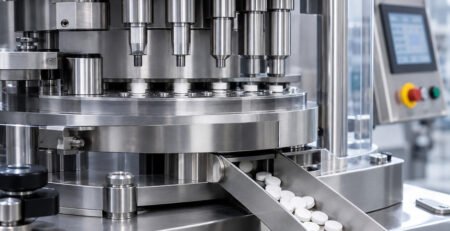
Die Produktionsgeschwindigkeit einer Tablettenpresse ist ein entscheidender Faktor für die Wirtschaftlichkeit industrieller Fertigungsprozesse. Ob in der pharmazeutischen Industrie, bei der...
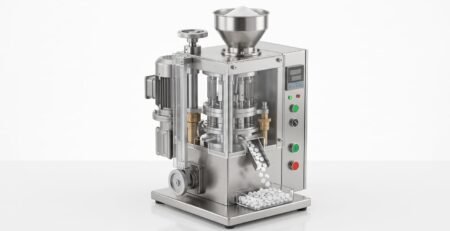
Eine moderne Tablettenpressmaschine ist das technologische Herzstück der modernen pharmazeutischen Produktion, der chemischen Industrie sowie der Herstellung von Nahrungsergänzungsmitteln. Als...
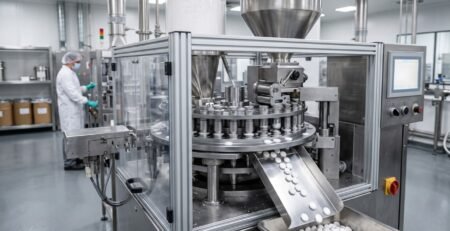
Die moderne Pharmaindustrie und die Nahrungsergänzungsmittelbranche stehen kontinuierlich vor der Herausforderung, enorme Stückzahlen bei gleichbleibend hoher Qualität zu produzieren. Hier...