


The Complete Guide to Pharmaceutical Tablet Compression (2026)
Die Tablette ist nach wie vor die dominierende feste orale Darreichungsform in der Pharmaindustrie, und das aus gutem Grund: Sie...
By
WORLDWIDE SHIPPING - Order now
Posted by:
Category:
Comments:
Post Date:
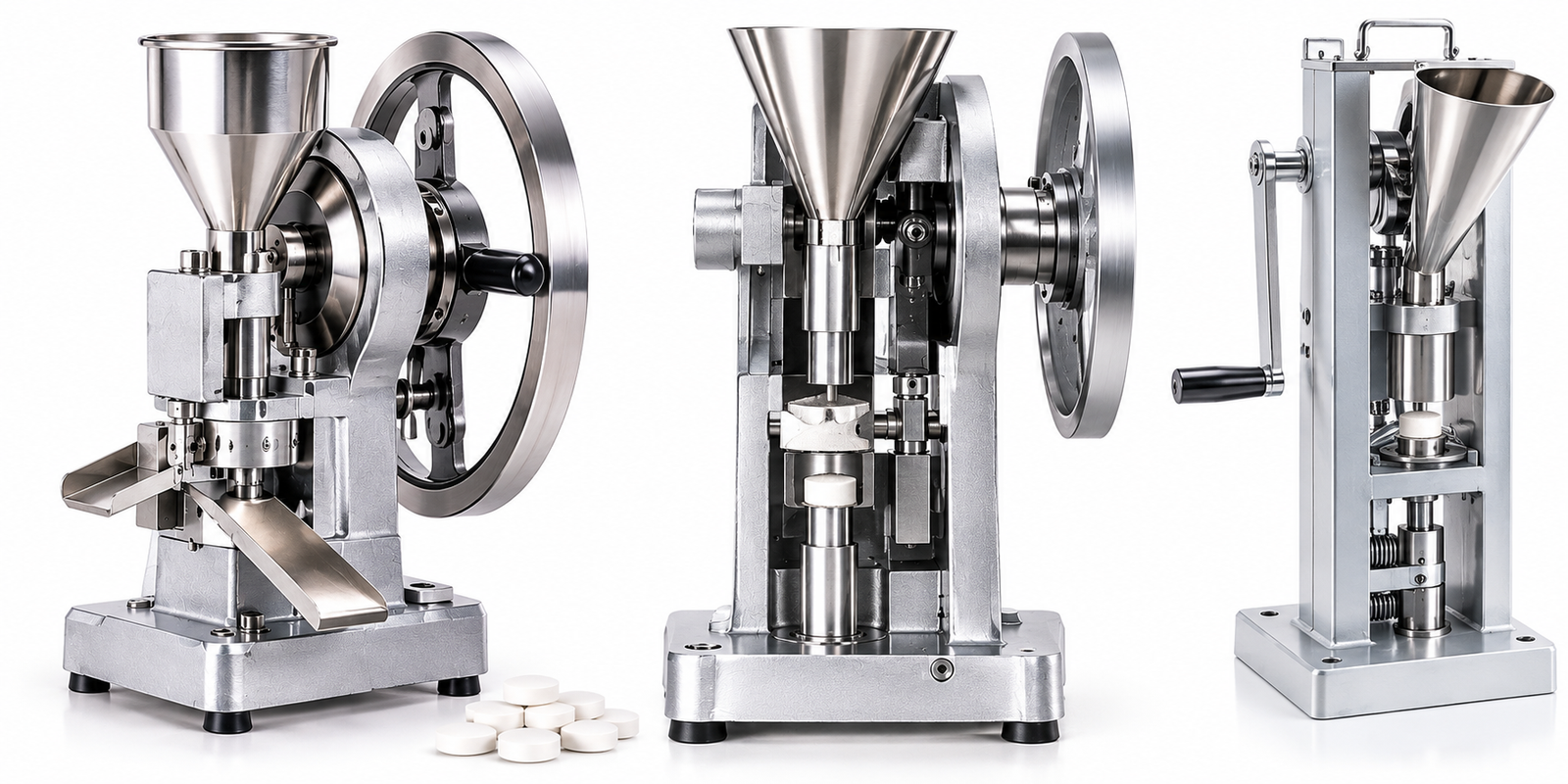
A single-station tablet press is a machine used to compress powder or granules into tablets. In this process, the material is compacted through pressure, resulting in a solid form.
The machine features a die and two punches: an upper punch and a lower punch. With this system, each tablet is pressed individually.
Single-station tablet presses are particularly well-suited for small production volumes, trials, and the development of new products. They are used, for example, in the following areas:
A major advantage of these machines is their simple design. They are compact, relatively inexpensive, and can be adjusted flexibly.
Compared to large industrial tablet presses, their production output is lower. On the other hand, they are particularly well-suited for small batches, laboratory trials, and the testing of new materials.
The basic principle is simple: powder or granules are placed into a mold and then pressed into a tablet under pressure.
The machine can be operated manually or by a motor. With manual models, the individual work steps are performed by the operator. Motor-driven models allow for faster and more consistent production.
A typical single-station tablet press consists of the following components:
The ejection setting determines how far the lower punch moves upward, allowing the finished tablet to be removed from the die.
The manufacturing process consists of five simple steps.
The upper punch is positioned outside the die. The lower punch is set in such a way that there is sufficient space for the powder.
The powder or granulate flows from the hopper into the opening of the die.
The fill depth is determined by the position of the lower punch. Depending on the setting, a greater or lesser amount of material enters the die.
The fill quantity influences the weight of the finished tablet. Excess material is removed prior to compression.
The upper punch moves downward and compresses the powder.
The pressure causes the individual particles to be pressed more closely together. As a result, the material takes on a solid form.
During this process, the lower punch normally remains in its set position.
After the pressing process, the upper punch moves back upward.
Subsequently, the lower punch moves upward and lifts the finished tablet out of the die. The tablet can now be removed.
The finished tablet is removed, and the die is refilled with material.
After that, the next pressing process begins.
This process repeats for every tablet.
To ensure the tablets achieve the desired quality, various settings must be adjusted to suit the formulation being used.
Fill quantity: It influences the weight of the tablet.
Pressing force: It influences the degree to which the material is compressed and how firm the tablet is.
Tablet shape and size: Diese werden hauptsächlich durch die verwendete Matrize und die Stempel bestimmt.
Pressgeschwindigkeit: Sie beeinflusst die Produktionsleistung und kann sich auf die Qualität der Tabletten auswirken.
Eigenschaften des Materials: Pulver und Granulate unterscheiden sich beispielsweise in ihrer Fließfähigkeit und ihrem Verdichtungsverhalten. Diese Eigenschaften müssen bei der Einstellung der Maschine berücksichtigt werden.
Vor der Produktion sollte geprüft werden, ob die Tabletten das gewünschte Gewicht, die richtige Form und eine ausreichende Festigkeit haben.
Erst wenn die Ergebnisse den Anforderungen entsprechen, sollte die Produktion unter den festgelegten Bedingungen fortgesetzt werden. Die Qualität muss regelmäßig kontrolliert werden.
Einstationen-Tablettenpressen bieten mehrere Vorteile:
Mit geeigneten Werkzeugen lassen sich beispielsweise runde oder anders geformte Tabletten herstellen. Dazu gehören bestimmte Nahrungsergänzungsmittel, pharmazeutische Tabletten und industrielle Presslinge.
Allerdings ist die Produktionsleistung begrenzt, da die Maschine nur eine Tablette pro Presszyklus herstellt. Außerdem muss der Bediener die Einstellungen und die Qualität der Tabletten sorgfältig überwachen.
Eine regelmäßige Wartung ist wichtig, damit die Maschine zuverlässig und sicher funktioniert.
Folgende Punkte sollten beachtet werden:
Die genauen Wartungs- und Sicherheitsschritte hängen vom jeweiligen Maschinenmodell ab. Deshalb haben die Angaben des Herstellers immer Vorrang.
Eine Einstationen-Tablettenpresse ist eine kompakte Maschine zur Herstellung von Tabletten aus Pulver oder Granulat.
Der Herstellungsprozess besteht aus fünf Schritten: Befüllen der Matrize, Einstellen der Füllmenge, Verpressen des Materials, Auswerfen der Tablette und Wiederholen des Vorgangs.
Die Maschine eignet sich besonders für Labore, Produktentwickler und kleine Produktionsbetriebe, die geringe Mengen herstellen oder neue Rezepturen testen möchten.
Ihre wichtigsten Vorteile sind die einfache Funktionsweise, die flexiblen Einstellungen und die vergleichsweise niedrigen Anschaffungskosten. Für eine gleichbleibende Produktqualität sind jedoch die richtige Einstellung, eine regelmäßige Qualitätskontrolle und eine sorgfältige Wartung entscheidend.
Die Tablette ist nach wie vor die dominierende feste orale Darreichungsform in der Pharmaindustrie, und das aus gutem Grund: Sie...
Die Produktionsgeschwindigkeit einer Tablettenpresse ist ein entscheidender Faktor für die Wirtschaftlichkeit industrieller Fertigungsprozesse. Ob in der pharmazeutischen Industrie, bei der...
Eine moderne Tablettenpressmaschine ist das technologische Herzstück der modernen pharmazeutischen Produktion, der chemischen Industrie sowie der Herstellung von Nahrungsergänzungsmitteln. Als...
Die moderne Pharmaindustrie und die Nahrungsergänzungsmittelbranche stehen kontinuierlich vor der Herausforderung, enorme Stückzahlen bei gleichbleibend hoher Qualität zu produzieren. Hier...