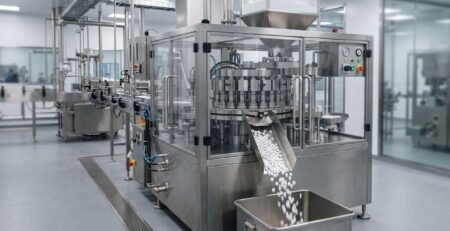
Modern tablet press machines: technology, functionality and applications
Modern tablet presses are a key component of the pharmaceutical, chemical, and food industries. They enable the precise production of tablets with consistent quality, defined drug dosage, and high production speed. Continuous technological advancements have transformed these machines from simple mechanical presses into highly automated systems that combine digital control, process monitoring, and real-time quality control. Increasing demands for product safety, efficiency, and flexibility are a major driver of innovation in this field.
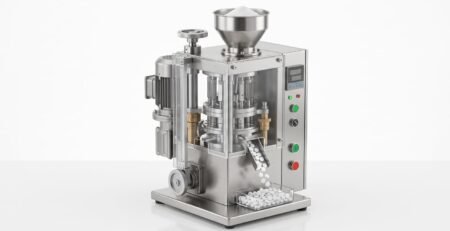
The fundamental task of a tablet press is to form powdered or granulated materials into solid tablets under high pressure. This process relies on the controlled compaction of the material within a die by upper and lower punches. Modern machines operate with precisely adjustable compression forces, ensuring that each tablet has identical physical properties such as weight, hardness, and disintegration time. Sensors continuously monitor parameters such as pressure profile, fill level, and production speed. Deviations are automatically detected and corrected, minimizing waste and increasing process reliability.
A key technological advancement of modern tablet presses lies in their high degree of automation. Digital control systems enable precise adjustment of production parameters to different formulations. Operators can analyze production data in real time and optimize processes without having to stop the machine. At the same time, integrated quality control systems ensure that defective tablets are detected and rejected early on. This not only reduces material waste but also meets stringent regulatory requirements, particularly in pharmaceutical production.
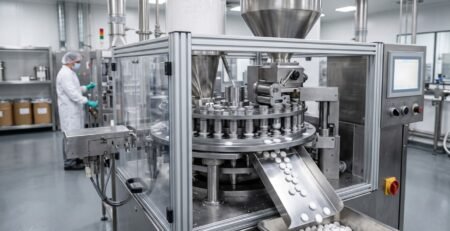
Besides the classic single-punch technology, rotary tablet presses with multiple pressing stations are now the dominant technology. These machines achieve extremely high production outputs and are particularly suitable for industrial mass production. The continuous rotation of the pressing system allows for the production of thousands of tablets per minute. At the same time, modern materials and precise manufacturing tolerances ensure a long tool life and consistently high product quality.
Another important aspect is the flexibility of modern equipment. Manufacturers increasingly need to produce smaller batches with different active ingredients, making rapid changeover times crucial. Innovative machine concepts enable tool-free replacement of certain components and automated cleaning systems. This significantly reduces downtime and supports hygienic production conditions, which are essential, especially in sensitive industries. Additionally, closed production systems help protect operators from potentially hazardous substances and prevent cross-contamination.
The integration of Industry 4.0 technologies is also playing an increasingly important role. Networked tablet presses can store and analyze production data and transmit it to central management systems. Predictive maintenance allows for the early detection of wear and tear and the avoidance of unplanned downtime. This reduces maintenance costs and significantly increases plant availability. At the same time, digital documentation facilitates compliance with legal regulations and simplifies audits and quality assurance.
The applications of modern tablet presses extend far beyond the pharmaceutical industry. In the food industry, they are used to manufacture dietary supplements, sweetener tablets, and functional products. In the chemical industry, they are used to produce cleaning and detergent tablets, while in the technical sector, they are used, for example, in the production of catalysts and ceramic components. Their ability to precisely compress different materials with varying properties makes these machines universal production solutions.
Future trends focus primarily on even greater process control, energy efficiency, and sustainability. New pressing systems reduce energy consumption through optimized power transmission and intelligent drive technologies. At the same time, improved simulation tools enable more precise development of tablet formulations even before production begins. Artificial intelligence is increasingly used to automatically adjust process parameters and predict production errors early on.
Overall, modern tablet presses represent a key technology for numerous industries. They combine mechanical precision with digital intelligence, enabling the economical, safe, and reproducible production of tablet products. With increasing automation and networking, their importance will continue to grow, as companies increasingly rely on efficient production processes and the highest quality standards.
FAQ – Moderne Tablettenpressmaschinen
1. Was ist eine Tablettenpressmaschine? Eine Tablettenpressmaschine ist eine industrielle Anlage, die Pulver oder Granulate unter hohem Druck zu festen Tabletten formt.
2. Welche Arten von Tablettenpressmaschinen gibt es? Es gibt Ein-Stationen-Pressen für kleine Chargen und Rotationspressen für die großindustrielle Massenproduktion.
3. Wie funktioniert eine moderne Tablettenpresse? Das Rohmaterial wird in eine Matrize gefüllt und anschließend durch Stempel mit hohem Druck zu einer Tablette gepresst.
4. In welchen Branchen werden Tablettenpressmaschinen eingesetzt? Hauptsächlich in der Pharmaindustrie, aber auch in der Lebensmittel-, Kosmetik- und Chemiebranche.
5. Welche Vorteile bieten moderne Tablettenpressmaschinen? Sie ermöglichen hohe Präzision, schnelle Produktion, Automatisierung und gleichbleibende Produktqualität.
6. Welche Technologien werden in modernen Pressmaschinen verwendet? Moderne Systeme nutzen digitale Steuerungen, Sensorik, Echtzeitüberwachung und teilweise KI-gestützte Prozessoptimierung.
Eine moderne Tablettenpressmaschine ist das technologische Herzstück der modernen pharmazeutischen Produktion, der chemischen Industrie sowie der Herstellung von Nahrungsergänzungsmitteln. Als...
Die moderne Pharmaindustrie und die Nahrungsergänzungsmittelbranche stehen kontinuierlich vor der Herausforderung, enorme Stückzahlen bei gleichbleibend hoher Qualität zu produzieren. Hier...
Die Herstellung von Tabletten hat sich im Laufe der Jahrzehnte von einem einfachen handwerklichen Prozess zu einer hochkomplexen, technologisch fortgeschrittenen...
Die pharmazeutische Produktion steht unter einem stetigen Druck, Durchsatzraten zu erhöhen, die Produktqualität zu stabilisieren und gleichzeitig die Betriebskosten durch...